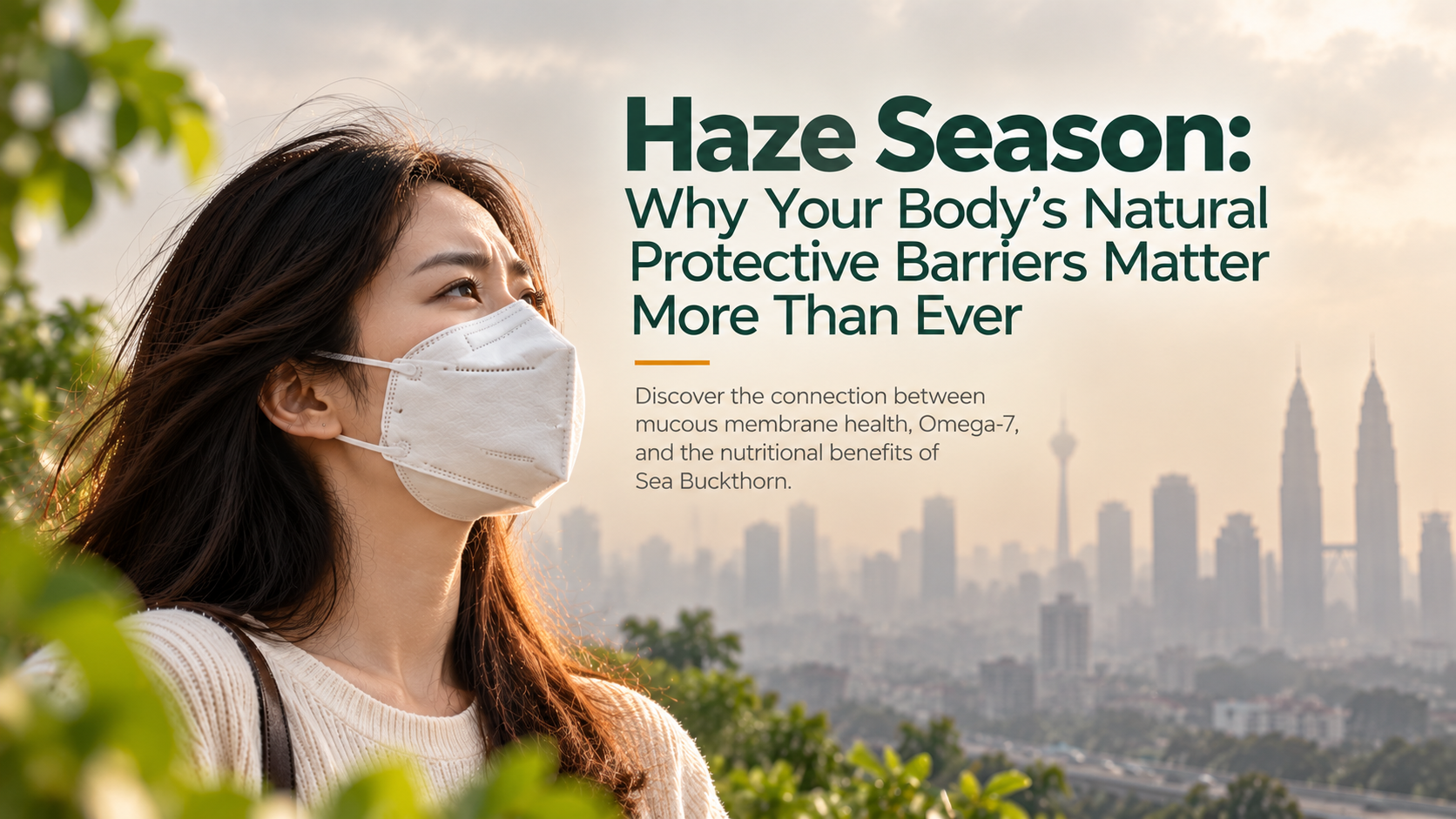
Discover the connection between mucous membrane health, Omega-7, and the nutritional benefits of Sea Buckthorn.
When haze fills the air, most of us immediately think about protecting our lungs. We stay indoors, wear masks, and monitor air quality readings. But have you ever considered how your body naturally protects itself from airborne pollutants?
Every day, our bodies rely on an important but often overlooked defence system: the mucous membranes.
These delicate protective linings are found throughout our respiratory system, including the nose, throat, and airways. They serve as one of the body's first lines of defence against environmental irritants.
As concerns about haze and air pollution continue, understanding how to care for these natural barriers is an important part of maintaining everyday wellness.
1. How Does Haze Affect Our Mucous Membranes?
Haze contains tiny airborne particles, including fine particulate matter known as PM2.5, which can travel deep into the respiratory system.
When we breathe polluted air, these particles may irritate the mucous membranes lining our nose, throat, and respiratory passages.
Common effects of haze exposure include:
-
Dryness or irritation in the nose and throat
-
Coughing and throat discomfort
-
Eye irritation and dryness
-
Increased respiratory discomfort, especially among sensitive individuals
Our mucous membranes play a vital role in helping to trap particles and support their removal through the body's natural mucus-clearing mechanisms.
Maintaining healthy mucosal function is therefore important for everyday respiratory wellness, particularly when environmental conditions are challenging.
2. The Mucous Membrane: Your Body's Natural Protective Layer
Think of your mucous membranes as a protective lining between your body and the outside environment.
These specialised tissues produce mucus, which helps keep surfaces moist, trap unwanted particles, and support normal protective functions.
Healthy mucous membranes rely on several factors, including adequate hydration, healthy epithelial cells, normal mucus production, and appropriate nutritional support.
When these protective surfaces become dry or irritated, they may become less effective at performing their normal functions.
This is where the role of dietary fats and specific nutrients becomes an interesting area of scientific research.
3. Omega-7: A Unique Fatty Acid Linked to Mucosal Health
Among the various nutrients found in nature, Omega-7, particularly palmitoleic acid, has attracted scientific interest for its potential relationship with skin and mucous membrane health.
Omega-7 is a monounsaturated fatty acid found in certain natural sources, including Sea Buckthorn.
Unlike Omega-3 and Omega-6, which are more widely recognised, Omega-7 is less commonly discussed in everyday nutrition.
Research has explored the possible role of Omega-7-containing Sea Buckthorn oils in supporting the condition and function of certain mucosal tissues.
Omega-7 is relevant to lipid metabolism and cellular function, while Sea Buckthorn's wider range of fatty acids and antioxidant compounds may also contribute to its biological effects.
An important distinction: Omega-7 is not the sole structural component of mucous membranes, and it has not been established that Omega-7 supplements protect the respiratory tract from haze. However, its potential relationship with mucosal tissue health makes it an interesting nutrient for ongoing research.

4. What Does Science Say About Sea Buckthorn and Mucous Membrane Health?
Scientific interest in Sea Buckthorn (Hippophae rhamnoides) continues to grow because of its naturally occurring bioactive compounds.
Sea Buckthorn contains a distinctive combination of nutrients, including:
-
Omega-3, Omega-6, Omega-7 and Omega-9 fatty acids
-
Naturally occurring carotenoids
-
Polyphenols and flavonoids
-
Vitamins and other antioxidant compounds
Research reviews have discussed Sea Buckthorn's potential anti-inflammatory and antioxidant activities, along with its possible relevance to maintaining skin and mucosal barrier integrity.
A review published in Lipids in Health and Disease examined Sea Buckthorn oil fatty acids, including Omega-7 palmitoleic acid, and discussed research involving skin and mucosal conditions.
These findings are encouraging from a nutritional science perspective. However, research involving Sea Buckthorn oils or concentrated extracts should not automatically be interpreted as proof of the same effects from every Sea Buckthorn-containing product.
Further human clinical studies are needed to understand how these findings apply to respiratory mucous membranes and environmental pollution exposure.
5. Discover Himalayan Tibetan Sea Buckthorn in CardiBerry®
At nutrioG®, we believe that everyday wellness begins with understanding the nutritional value of nature.
This philosophy is reflected in CardiBerry®, our plant-based nutritional supplement formulated with Himalayan Tibetan Sea Buckthorn.
Sea Buckthorn is valued for its naturally occurring fatty acids, including Omega-7, alongside a broad spectrum of other bioactive compounds.
CardiBerry® combines Sea Buckthorn with four complementary ingredients:
Sea Buckthorn: A distinctive botanical source of naturally occurring Omega-3, 6, 7 and 9 fatty acids and other phytonutrients.
Goji Berry: Known for its naturally occurring carotenoids and antioxidant compounds.
Cranberry: Contains naturally occurring polyphenols and other plant compounds.
Strawberry: Contributes naturally occurring fruit phytonutrients.
Coenzyme Q10 (CoQ10): A compound involved in normal cellular energy production.
Together, these ingredients form CardiBerry®'s unique plant-based nutritional formulation, designed to complement a balanced lifestyle and support everyday well-being.
With Sea Buckthorn at its heart, CardiBerry® brings attention to a lesser-known aspect of botanical nutrition: the scientific interest in Omega-7 and mucosal health.
6. Simple Ways to Care for Yourself During Haze Season
While nutrition contributes to overall wellness, reducing exposure to polluted air remains the most important step during haze episodes.
Here are several practical habits to consider:
-
Monitor the Air Pollutant Index (API). Stay informed about local air quality and adjust outdoor activities accordingly.
-
Reduce outdoor exposure. Limit strenuous outdoor exercise when pollution levels are elevated.
-
Wear an appropriate respirator. A properly fitted N95 or equivalent particulate respirator can help reduce exposure when outdoor activities are unavoidable.
-
Stay adequately hydrated. Drinking sufficient water supports normal bodily functions, including healthy mucosal secretions.
-
Maintain balanced nutrition. Include a variety of fruits, vegetables, healthy fats, and nutrient-rich foods in your daily diet.
Nutritional supplements such as CardiBerry® can be part of a balanced wellness routine, but they do not replace protective measures against haze exposure.
7. A New Perspective on Everyday Wellness
Haze reminds us how closely our well-being is connected to the environment around us.
Beyond protecting ourselves externally, it is equally valuable to understand the natural barriers that help our bodies function every day.
As research continues to explore the relationship between Sea Buckthorn, Omega-7, and mucosal health, this remarkable botanical ingredient offers an interesting perspective on the role of nutrition in overall wellness.
Healthy living begins with informed choices, balanced nutrition, and caring for the body from within.
Discover the botanical nutrition behind CardiBerry®, powered by Himalayan Tibetan Sea Buckthorn.
Energy Up. Mind On.
Explore more at www.nutrioG.com
Scientific References
-
The impact of sea buckthorn oil fatty acids on human health. Lipids in Health and Disease (2019). https://pmc.ncbi.nlm.nih.gov/articles/PMC6589177/
-
Song X. et al. The role of sea buckthorn in skin and mucosal health: a review from an anti-inflammatory perspective. Frontiers in Pharmacology (2025). https://pmc.ncbi.nlm.nih.gov/articles/PMC12644098/
-
The bioactive components as well as the nutritional and health effects of sea buckthorn. https://pubmed.ncbi.nlm.nih.gov/35516250/
Disclaimer: This article is intended for educational purposes only. CardiBerry® is a nutritional supplement and is not intended to prevent, treat, or cure respiratory conditions or illnesses associated with haze exposure.